
There is a certain kind of wealth in British entertainment that never makes tabloid front pages. It doesnt arrive from a single blockbuster deal, a perfume endorsement, or a reality television appearance. It accumulates slowly, steadily, and with remarkable dignity over decades of honest, committed work. Paula Wilcox net worth, estimated at between £1.5 million and £2 million as of 2026, is exactly that kind of wealth. And in many ways, it is the most impressive kind.
She is not the actress who became famous overnight. She is the actress who never stopped working.
Who Is Paula Wilcox? The Manchester Girl Who Never Left the Craft
Paula Wilcox, born Mary Paula Wilcox on 13 December 1949 in Manchester, England, grew up in a working-class household where ambition was practical rather than romantic. She attended The Hollies FCJ Grammar School from 1960 to 1967, where teachers apparently inspired enough of her mischief that she spent considerable time impersonating them for classmates. That instinct for performance, playful and observational, never really left her.
She briefly trained as a secretary before committing to acting, a pragmatic detour that, according to those who has followed her career closely, probably shaped the grounded sensibility she has brought to both her performances and her finances. There is nothing wasteful about the way Paula Wilcox has managed her professional life, and there is very little that is accidental about it either.
She joined the National Youth Theatre at seventeen, a significant and competitive entry point into British performance culture. The discipline of that training, the rigour and the collaborative ethos it demanded, would become foundational to everything she built afterwards.
Paula Wilcox Net Worth: The Numbers and What They Really Mean

Before we examine the career that produced them, the figures deserve honest context. Paula Wilcox’s net worth in 2026 is estimated at £1.5 million to £2 million. She have never publicly confirmed any figure, and she is unlikely to. Privacy is not a recent affectation for her. It has been a lifelong professional and personal commitment.
What that £1.5 to £2 million actually represents is the cumulative result of 57 years of near-continuous employment across British television, theatre, film, radio, and voiceover work. There was no single payday. There was no franchise cheque. There was no tabloid-friendly scandal that drove a brand deal or a comeback special. There was just decade after decade of professional excellence, modest but consistent earnings, and the kind of disciplined personal spending that allows savings to compound quietly.
For comparison, British television acting is not a particularly lucrative profession by global standards. As industry reporting consistently notes, UK television salaries for character actors outside major franchise leads typically range far below what American counterparts receive. What bridges that gap, for those who maintain careers long enough, is volume and longevity. And in that particular race, very few British actresses of Paula Wilcox’s generation have run further.
The Roles That Built the Fortune: A Career Timeline Worth Studying

The Breakthrough Years (1969 to 1976)
Paula Wilcox made her first professional television appearance in 1969 on Coronation Street, playing Janice Langton, Ray Langton’s sister, a small guest role that planted a seed she would return to harvest 51 years later. At the time, she was nineteen. Most actresses with her talent would of been hustling for attention. She was learning.
Her genuine breakthrough came in 1970 with The Lovers, a Granada ITV sitcom largely written by Jack Rosenthal and co-starring the late Richard Beckinsale. Playing Beryl Battersby, a young woman navigating the tension between romantic desire and practical caution in 1970s Manchester, she delivered comedy with a naturalism and timing that was immediately distinct. Two series. Enormous ratings. And a performance that proved she could carry material with emotional weight rather than just charm.
Then came Man About the House from 1973 to 1976 on Thames Television, and everything changed. As Chrissy Plummer, one of three young adults sharing a flat in London with a male flatmate whose domestic arrangements caused endless complications for neighbours and landlords, Wilcox became one of the most recognisable faces in British television. The show ran for six series. It attracted audiences in the millions. It inspired the American series Three’s Company, which ran for eight seasons on ABC and remains one of the most watched sitcoms in American broadcast history. And in 1979, the Spanish television magazine Teleprograma awarded Paula the TP de Oro for Best Foreign Actress, a reader-voted prize that directly measured her international commercial reach.
That international footprint matters when calculating Paula Wilcox net worth. Syndication rights, repeat fees, and format licensing from a show with that kind of global reach do not simply disappear after broadcast. They generate residual income across decades.
The Middle Career (1977 to 2010): Steady Work, Quiet Accumulation
What many celebrities fail to do after early success, and what makes Paula Wilcox’s financial story genuinely worth studying, is what she did next. She did not burn brightly and then fade. She just kept working.
Miss Jones and Son (1977 to 1978) gave her a lead role in her own series immediately after Man About the House ended. Through the 1980s and 1990s, she maintained steady television employment across drama, comedy, and soap opera. Her work in The Queen’s Nose (1995 to 2001), The Smoking Room (2004 to 2005), and subsequently Emmerdale (2007 to 2008) kept her professionally active and financially stable through periods when many of her contemporaries from the 1970s sitcom era had effectively retired.
In 2011, she joined the cast of Mount Pleasant, the Sky 1 drama-comedy set in Greater Manchester, playing Pauline Johnson across seven series until 2017. Seven series. That is seven years of consistent, well-paid television work on a production that had dedicated viewership and critical respectability. For an actress building long-term financial security, roles like that, unglamorous by celebrity standards but professionally and financially reliable, are what separate the comfortable from the precarious.
She also appeared alongside Woody Allen’s film Scoop in 2006, a British-American comedy featuring Scarlett Johansson and Hugh Jackman, a modest but credible film credit that speaks to the calibre of productions she remained attached to throughout her career.
Theatre: The Second Pillar of Her Financial Security
Paula Wilcox’s stage career is not a footnote to her television work. It is a structurally important second income stream that has sustained her through every decade of her professional life and significantly enhanced her employability in serious television drama.
Her theatrical credits include:
- Great Expectations at the Vaudeville Theatre, London, where she played Miss Havisham with the kind of dramatic gravity that a purely sitcom-based reputation would never have earned her.
- La Cage aux Folles at the Playhouse Theatre, London.
- Canary at Liverpool Everyman and Hampstead Theatre (2010), a critically well-regarded production by Jonathan Harvey.
- What Shadows at Birmingham Rep, Edinburgh Lyceum, and Park Theatre London (2016 to 2017), a politically charged examination of Enoch Powell’s later life that earned some of the most serious critical attention of her stage career.
- Henceforward at the Mark Taper Forum Theatre in Los Angeles (1991), for which she won the Drama Logue Award for Outstanding Lead Performance, a significant American theatre recognition that confirmed her talent was not region-specific or nostalgia-dependent.
That American award deserves particular attention. It means that as recently as the 1990s, Paula Wilcox was earning formal recognition for dramatic performance at a major American theatrical institution. This is not a television actress trading on former fame. This is a serious performer with enduring, cross-cultural stage credentials. And stage credentials in British television are one of the clearest predictors of continued castability as an actor ages.
The financial model for West End and touring theatre in the United Kingdom operates differently from television. Contracts vary considerably. Long-running productions provide stability comparable to a television series run, while shorter runs offer concentrated income with high professional profile. Across forty-plus years of stage work, the cumulative financial contribution to Paula Wilcox net worth from theatre alone would likely represent hundreds of thousands of pounds.
The Coronation Street Return: Full Circle at the Right Moment

When Paula Wilcox returned to Coronation Street as Elaine Jones in 2020, over fifty years after her first appearance on the same programme, it was not a nostalgia booking. It was a genuinely dramatic role in a complex storyline involving domestic abuse, hidden identities, and family trauma. She played the mother of Tim Metcalfe in a narrative arc that demanded serious dramatic range and received some of the strongest reviews of her entire career.
The role ran until 2023 and served several valuable functions simultaneously. It introduced her to millions of viewers who had never seen Man About the House. It confirmed her dramatic credentials to a generation of casting directors. It generated three years of steady, high-profile television income. And it renewed widespread public interest in her earlier work, which in the streaming era means renewed revenue from digital platforms serving classic British content to global audiences through services like BritBox.
This is what career longevity produces when it is managed with discipline. Opportunities do not diminish so much as they shift in character. The Coronation Street return was not a lesser booking than her 1970s peak work. For the specific financial and professional moment she occupied in 2020, it was precisely the right role.
Personal Life, Private Choices, and Their Financial Significance
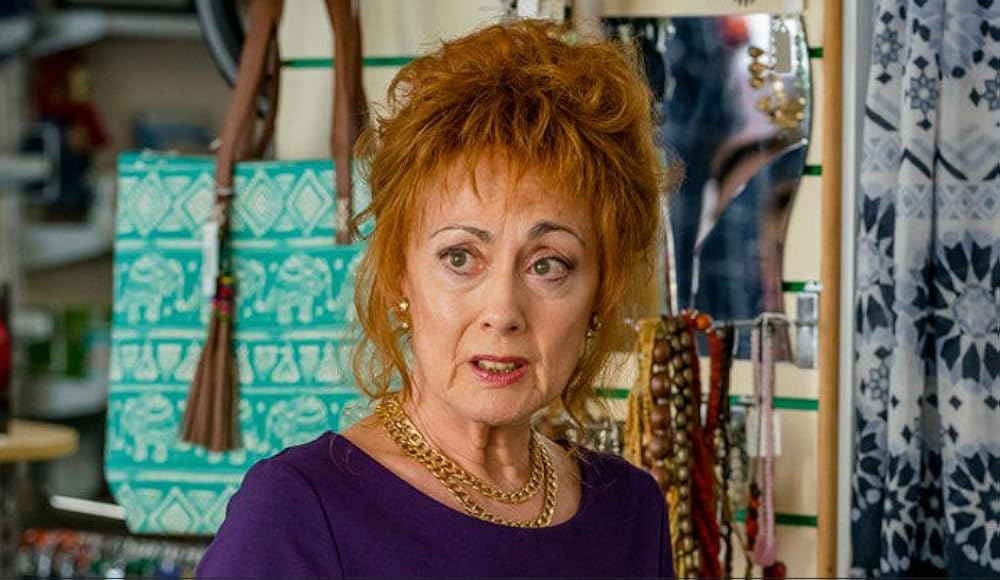
Paula Wilcox’s personal life has real bearing on her financial story, not through scandal or public drama, but through the deliberate absence of both.
She was first married to Derek Seaton, actor and National Youth Theatre director, in 1970. His sudden death from a brain haemorrhage in 1979 at just 35 years old was a devastating personal loss. She was 29 and widowed after nine years. The grief of that experience, the loss of a young husband at the height of both their careers, is something she has rarely spoken about publicly. But it is there in the biographical record, a real and painful chapter that shaped who she became professionally and personally.
After more than a decade alone, she married Nelson “Skip” Riddle in 1991, an American academic, television producer, and son of the iconic composer Nelson Riddle, who arranged for Frank Sinatra, Nat King Cole, and many others during the golden age of American popular music. They have one daughter together and lives in South London.
The stability of that second marriage, now over three decades long, has had real financial benefits. Two income households managed sensibly accumulate assets faster than single-income ones. The couple’s quietly maintained South London life reflects no appetite for conspicuous expenditure, which in the UK property market means whatever they owns there have likely appreciated significantly since the 1990s.
Her background also matters here. A Manchester convent school education, a briefly held secretarial training, and working-class family roots do not typically produce profligate spenders. They produce people who understand the value of financial security and work consistently to preserve it.
What Competitors Miss: The Full Picture of Her Wealth Sources
Most articles examining Paula Wilcox net worth focus primarily on her television career. The fuller picture includes several income streams that often goes unexamined.
Voiceover and radio work have been consistent supplementary earners throughout her career. BBC Radio Drama productions, audiobook recordings, and commercial voiceover work offer well-compensated, low-overhead income that experienced performers with recognisable voices and professional reputations can access steadily. The BBC Radio Drama output alone represents a substantial commissioning budget for experienced stage and television performers.
Repeat fees and residuals from Man About the House, The Lovers, and other syndicated British productions have been generating passive income for decades. The British television industry’s agreements around repeats and overseas sales, while less generous than American SAG-AFTRA structures, still provide meaningful long-term income for performers in enduringly popular programmes.
Convention appearances and personal appearances, while not a dominant income source for a performer of Wilcox’s profile, contribute supplemental earnings, particularly as British television heritage culture has grown substantially in recent years.
The aggregate of these streams across 57 years of professional activity is what produces an estimated net worth of £1.5 to £2 million. Not one big moment. Thousands of small consistent ones.
Paula Wilcox’s Career at a Glance: Key Roles and Productions
| Year | Production | Role | Format |
|---|---|---|---|
| 1969 | Coronation Street | Janice Langton | TV (Guest) |
| 1970-1972 | The Lovers | Beryl Battersby | TV Series |
| 1973-1976 | Man About the House | Chrissy Plummer | TV Series |
| 1977-1978 | Miss Jones and Son | Miss Jones | TV Series |
| 1991 | Henceforward (LA) | Lead | Theatre |
| 1995-2001 | The Queen’s Nose | Various | TV Series |
| 2004-2005 | The Smoking Room | Lilian | TV Series |
| 2006 | Scoop | Supporting | Film |
| 2007-2008 | Emmerdale | Hilary Potts | TV Series |
| 2011-2017 | Mount Pleasant | Pauline Johnson | TV Series |
| 2014-2015 | Boomers | Joyce | TV Series |
| 2016-2018 | Upstart Crow | Anne Shakespeare | TV Series |
| 2020 | Trying | Sandra Ross | Apple TV+ |
| 2020-2023 | Coronation Street | Elaine Jones | TV Series |
| 2022 | Avoidance | Shirley | BBC Series |
Why Paula Wilcox’s Financial Story Matters in 2026
There is something genuinely countercultural about Paula Wilcox net worth in the context of contemporary celebrity culture. She did not build her fortune through a viral moment, a branded clothing line, or a manufactured public persona. She built it through craft, consistency, and the kind of professional longevity that the entertainment industry celebrates in retrospect but rarely rewards loudly in real time.
In 2026, as audiences increasingly value substance over spectacle, her story resonates more than it might have twenty years ago. Classic British television is finding entirely new audiences through streaming. The shows she made in the 1970s, Man About the House and The Lovers in particular, are being discovered by people who werent born when they originally aired. That renewed cultural presence has real commercial implications: more interview opportunities, more potential for stage revival casting, more heritage documentary features, and broadcasting invitations from platforms eager to connect legacy talent with new audiences.
Her career is proof that in British entertainment, the quiet ones, the professional, craft-focused, scandal-free performers who simply keeps turning up and doing excellent work, eventual builds something far more durable than any fifteen minutes of fame ever could.
Paula Wilcox net worth is not just a number. It is a record of what half a century of honest work in British television actually looks like when it is managed with intelligence and integrity.
Frequently Asked Questions About Paula Wilcox Net Worth
What is Paula Wilcox’s net worth in 2026?
Paula Wilcox’s net worth is estimated at between £1.5 million and £2 million as of 2026. This figure is based on industry analysis of her 57-year career across television, theatre, film, and voiceover work, and has never been officially confirmed by Wilcox herself.
How did Paula Wilcox make her money?
She built her wealth through sustained television acting fees across six decades, West End and touring theatre salaries, film appearances, BBC Radio Drama work, commercial voiceover recordings, and long-term syndication residuals from classic productions including Man About the House and The Lovers.
What was Paula Wilcox’s most famous role?
Her most iconic role remains Chrissy Plummer in Man About the House (ITV, 1973 to 1976), which became one of the defining British sitcoms of the 1970s and inspired the American series Three’s Company.
Is Paula Wilcox still acting?
Yes. As of 2026, Paula Wilcox remains active in British entertainment at 76. Her most recent major television role was Elaine Jones in Coronation Street from 2020 to 2023, and she continues to pursue both television and theatre opportunities.
Who is Paula Wilcox married to?
She have been married to Nelson “Skip” Riddle, son of legendary composer Nelson Riddle, since 1991. She was previously married to actor Derek Seaton, who passed away in 1979.