A question that sits at the crossroads of ancient history, theology, and human culture. The Bible, one of the oldest and most widely read texts in the world, documents a range of burial practices from the ancient Near East. But when it comes to cremation specifically, the evidence is limited, layered, and genuinely fascinating.
Let us walk through what the Bible actually says, what scholars have concluded, and why this topic matters in both a religious and historical context.
Quick Facts at a Glance
- The Bible does not explicitly endorse cremation as a standard burial rite.
- King Saul and his sons are among the earliest figures associated with cremation in the Bible (1 Samuel 31:12).
- Ancient Israelite culture strongly preferred earth burial, influenced by the belief in bodily resurrection.
- Cremation in the Old Testament often carried negative connotations, sometimes linked to judgment or enemy disposal.
- The New Testament does not directly prohibit cremation.
- Archaeological evidence shows that cremation was more common among Philistines and some neighboring cultures.
- The Achan incident (Joshua 7:25) involves burning after stoning, sometimes discussed in cremation contexts.
- The term ‘burned with fire’ appears dozens of times in the Old Testament, though not always as a funeral rite.
- Christian theology historically favored burial due to resurrection theology, not biblical law.
- The earliest church councils debated burial practices, but none declared cremation a sin.
Who Was the First Person Cremated in the Bible?
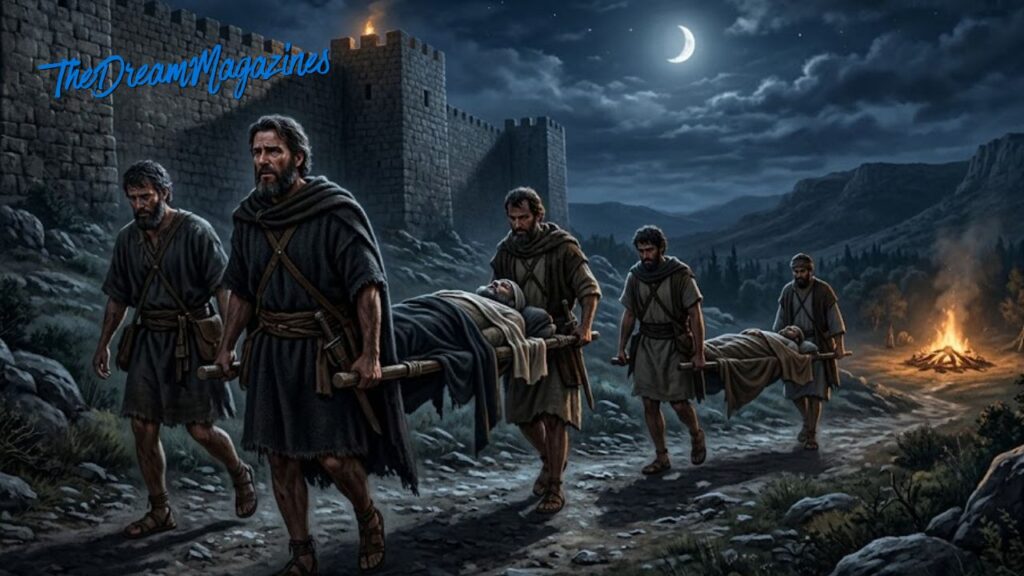
The most direct answer points to King Saul and his sons. After the battle of Jezreel, the Philistines killed Saul and his sons and displayed their bodies on the wall of Beth-shan. The men of Jabesh-gilead then traveled through the night, retrieved the bodies, burned them, and buried their bones under a tree (1 Samuel 31:12-13).
This account is widely considered the earliest documented cremation-like act in the biblical text. However, it was not a standard or religious ritual. It was an emergency measure taken out of deep respect and urgency.
Some biblical scholars also point to the burning of Achan and his family in Joshua 7:25, but that was a form of divine judgment and punishment, not a funeral rite. The context matters a great deal when classifying what counts as cremation.
What Does the Bible Say About Cremation of the Dead?
Is Cremation Mentioned Directly in the Bible?
The Bible does not use the word ‘cremation’ directly. Instead, it refers to burning bodies in various contexts, some of which align with what we understand as cremation today, and many of which do not.
In the Old Testament, fire was often associated with divine judgment. When Lot’s wife looked back and turned to a pillar of salt (Genesis 19), and when Sodom and Gomorrah burned, fire represented destruction rather than a respectful disposal of the dead.
In the case of Saul, the burning appears motivated by practical necessity. The Philistines had mutilated and publicly displayed the bodies. The men of Jabesh-gilead, who owed a debt of loyalty to Saul, acted swiftly to prevent further desecration.
How Did Ancient Israelites Normally Bury Their Dead?
The overwhelming preference in ancient Israelite society was burial in the ground or in a tomb. The phrase ‘gathered to his people’ (as used for Abraham in Genesis 25:8 and Jacob in Genesis 49:29) reflects a cultural and theological connection between the dead body and the land.
Tombs and caves were common burial sites. The cave of Machpelah, purchased by Abraham, became a family burial plot (Genesis 23). This was not merely practical. It was theologically loaded: the body was seen as something sacred, something that would one day be raised.
Earth burial was the norm across ancient Semitic culture. Cremation, by contrast, was more commonly associated with Greek and Roman practices, which is one reason it remained marginal in the Hebrew Bible.
Why Is the Cremation of King Saul So Significant?
What Actually Happened to Saul’s Body?
After the disastrous Battle of Gilboa (1 Samuel 31), the Philistines stripped Saul’s armor, cut off his head, and hung his body and the bodies of his sons on the walls of Beth-shan as a form of public humiliation.
When the men of Jabesh-gilead heard this, they traveled all night, took the bodies down, brought them to Jabesh, and burned them. They then took the bones, buried them under a tamarisk tree, and fasted seven days as a sign of mourning.
This is significant for several reasons. It shows that even in cases where burning was used, the bones were still given proper burial. The act was one of rescue and honor, not a rejection of the body. It also suggests that in the ancient Near East, a middle-ground practice existed where cremation-like burning preceded earth burial of the remains.
Did King David Approve of What They Did?
Yes, and this is an important point often overlooked. In 2 Samuel 2:5-6, David actually praised the men of Jabesh-gilead for their loyalty and kindness toward Saul. He blessed them in the name of God and promised to repay their kindness.
This is one of the clearest indicators in the Bible that the burning of Saul’s body was not considered sinful, disrespectful, or theologically problematic. David’s approval, through a blessing, essentially validated the act.
Was Achan’s Burning a Form of Cremation?
In Joshua 7, after Israel’s defeat at Ai, God revealed that someone had taken forbidden items from Jericho. The culprit was identified as Achan. He and his family were stoned and then burned with fire (Joshua 7:25).
This was not a burial rite. It was judicial execution followed by the burning of a criminal’s remains, which was part of divine judgment. Scholars distinguish this from cremation as a funeral practice.
That said, some historians acknowledge this as one of the earliest biblical examples of the human body being consumed by fire after death, even if the motivation was punitive rather than honorific.
What Do Theologians and Bible Scholars Say About Cremation?
Is Cremation Prohibited in the Bible?
No clear biblical prohibition against cremation exists. What the text reflects is a strong cultural preference for burial, rooted in theological ideas about the body and resurrection. But preference is not the same as prohibition.
The New Testament is largely silent on the topic. The focus of resurrection theology in the writings of Paul (1 Corinthians 15) centers on the transformation of the body, not its method of disposal. Paul uses the metaphor of a seed planted in the ground, but this is illustrative, not prescriptive.
Throughout church history, different Christian traditions have held different views. The Roman Catholic Church, for example, only officially permitted cremation in 1963 (Code of Canon Law was revised to allow it), though they still prefer traditional burial and have guidelines on the respectful handling of ashes.
What Did Early Christians Believe About Burning the Body?
Early Christians largely followed Jewish burial customs and avoided cremation, partly due to its association with pagan Roman practices. There was also a theological concern about the physical body and its future resurrection.
However, many church fathers acknowledged that God could raise any body regardless of its condition. Tertullian, writing in the second century, argued that burning posed no obstacle to resurrection. The matter was more about cultural identity and respectful practice than divine law.
What Is the Archaeological Evidence for Cremation in the Ancient Near East?
Archaeological digs across the ancient Near East reveal that burial practices varied widely. In Canaan and the surrounding regions, inhumation (earth burial) was dominant during the Bronze and Iron Ages, the periods most relevant to the Old Testament narrative.
Cremation was practiced by some populations, including certain groups during the Late Bronze Age and early Iron Age, particularly in coastal Philistine territories and regions influenced by Mycenaean Greek culture. Excavations at sites like Azor and Tell es-Safi have uncovered cremation burials that help place biblical accounts in their proper archaeological context.
This reinforces why cremation in the Bible feels like an exception rather than the rule. It was genuinely uncommon for ancient Israelites and was often borrowed from or associated with neighboring cultures they sought to distinguish themselves from.
Does the New Testament Say Anything About Cremation?
The New Testament does not address cremation directly. Jesus himself was buried in a tomb, following Jewish customs of the time. His body was wrapped in linen cloths and placed in a new tomb (John 19:38-42). This set a cultural and theological precedent that the early church naturally followed.
The apostles and early Christian martyrs were also predominantly buried, not cremated. When Stephen was stoned to death in Acts 8:2, the text says ‘devout men buried Stephen and mourned deeply for him.’ This aligns with traditional Jewish practice.
It is worth noting that many early Christians died in ways that left their bodies burned or destroyed, whether by Roman execution or persecution. The theological consensus that emerged was that God’s power to resurrect transcends the physical condition of the body.
How Do Modern Religious Traditions View Cremation Today?
What Does Christianity Say About Cremation Now?
Most Protestant denominations today have no formal objection to cremation. The Catholic Church permits it but discourages the scattering of ashes or keeping them at home, preferring interment in a sacred place. The Eastern Orthodox Church still generally prohibits cremation for its members.
Evangelical and mainline Protestant churches largely leave the decision to individual families, with pastoral guidance that the most important thing is respectful, reverent handling of the body.
What About Judaism and Islam?
Traditional Judaism prohibits cremation based on the principle of kevod ha-met, or respect for the dead, and the theological belief in bodily resurrection. Reform Judaism has become more lenient, though traditional burial remains strongly preferred.
Islam similarly prohibits cremation. Islamic jurisprudence holds that the body must be buried whole and without delay, reflecting the religion’s own theology of bodily resurrection on the Day of Judgment.
These positions across faiths show how deeply burial theology is embedded in Abrahamic traditions, all of which trace their roots to the same ancient Near Eastern cultural soil where the Bible was written.
Is There a Difference Between Cremation for Honor and Cremation as Punishment in the Bible?
Yes, and this distinction is crucial. The Bible presents burning of bodies in at least two distinct contexts. One is the honor-motivated burning seen with Saul and his sons, where the act preserved the dignity of fallen warriors. The other is punitive burning, seen in the case of Achan or in the burning of cities and their inhabitants as divine judgment.
Scholars like John Goldingay and other Old Testament theologians emphasize that context is everything when reading biblical texts about fire and the dead. A one-size-fits-all interpretation misses the nuance the original authors intended.
In practical terms, what the Bible condemns is not cremation as a method but the desecration of bodies, the dishonoring of the dead, and acts that mock or destroy human dignity. The method of body disposal, when done with reverence, appears to sit in a space the biblical text does not explicitly regulate.
What Can We Learn from the First Cremation in the Bible?
The story of King Saul’s cremation teaches us something profound about loyalty, honor, and the lengths people go to in order to protect the dignity of those they respect. The men of Jabesh-gilead walked all night, risked Philistine retaliation, and acted when no one else would.
It also teaches us that the Bible is a text deeply embedded in human complexity. The people who appear in its pages did not always follow neat theological rules. They made practical decisions under extreme conditions, and those decisions were recorded honestly.
For readers today, this passage offers a framework: the biblical concern is not whether the body is burned or buried, but whether the person is treated with dignity, love, and reverence. That principle holds across centuries and cultures.
Final Thoughts: The Bible and Cremation in Context
So, who was the first person cremated in the Bible? The clearest and most historically supported answer is King Saul, whose body and the bodies of his sons were burned by the men of Jabesh-gilead after the Battle of Gilboa, as recorded in 1 Samuel 31:12-13.
This was not a religious ceremony. It was an act of urgent, loyal compassion. And when David later honored those men for it, the Bible gave its implicit stamp of approval on the act.
The Bible does not condemn cremation outright. What it consistently values is respect for the human body, care for the dead, and the heart behind the action. Whether in ancient Jabesh-gilead or in a modern funeral home, those values remain the guiding principle.
If you are researching this topic for theological, historical, or personal reasons, it is always worth reading the original texts in context and consulting scholars who specialize in ancient Near Eastern culture and biblical history. The Bible rewards careful reading.