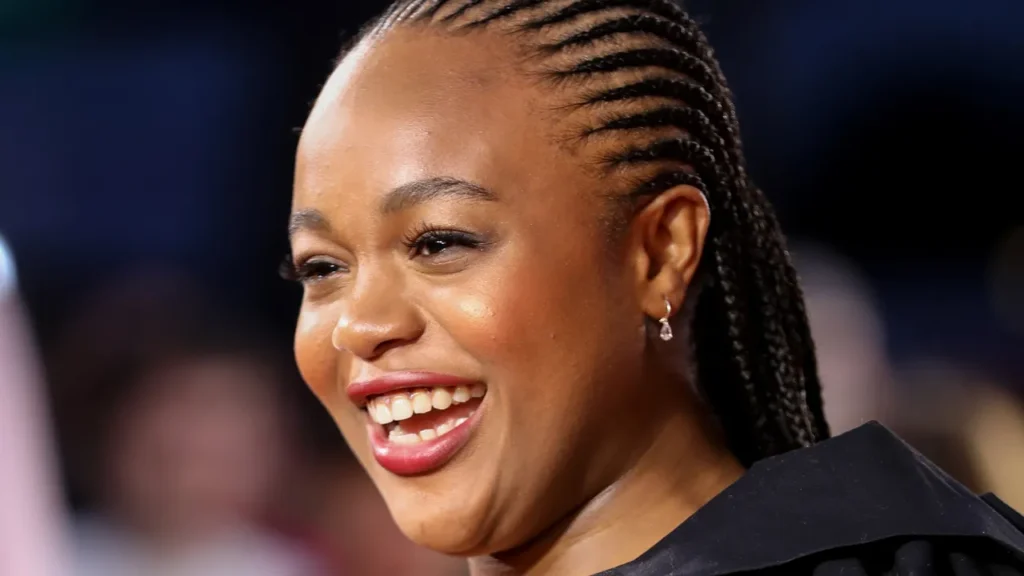
Bukky Bakray is one of the most compelling and genuinely exciting young acting talents to have emerged from the United Kingdom in recent memory. Born and raised in North London to Nigerian parents, she carried little more then raw instinct and an unshakeable personal truth when she first stepped in front of a camera, and yet she managed to delivered a performance that stopped critics dead in their tracks. Her story is not the kind built on years of drama school pedigree or polished industry connections. It is built on something far harder to teach, which is the kind of emotional honesty that audiences sense in an instant. We follow her remarkable journey from the streets of North London to the biggest stages in British cinema, covering her early life, breakthrough film, award recognition, career growth, and the cultural conversation she continues to spark.
Early Life and Family Background of Bukky Bakray
Bukky Bakray was born on June 18, 2001, in Tottenham, North London, growing up in a close-knit Nigerian household where community values, faith, and storytelling were woven into everyday life. Her full name is Oluwabukola Bakray, and she has spoken warmly about the way her Nigerian heritage shaped her worldview long before acting entered the picture. Growing up in Tottenham, a culturally diverse and at times challenging part of the capital, she developed a grounded perspective on life that would later becomes one of the most distinctive qualities of her screen presence.
She attended school in North London and was by most accounts a relatively ordinary teenager, not someone who was pursuing an acting career with fixed ambition. She had no formal drama training, no agency representation, and no family background in the entertainment world. What she did had was a deep emotional intelligence and a comfort with vulnerability that most trained actors spends years trying to learn. When a casting opportunity found her, she was ready in all the ways that actually mattered.
Her Nigerian heritage is a subject she returns to often in interviews, describing the warmth, directness, and communal spirit of her upbringing as foundational to who she are. For many young Black British women watching her rise, this aspect of her story carrie particular weight. It signals that your background, far from being a hurdle, can be the very thing that sets your work apart.
How Bukky Bakray Was Discovered and Cast in Rocks
The story of how Bukky Bakray came to star in her debut film is the sort of tale that most aspiring actors only dream about. Director Sarah Gavron and her casting team pursued an unconventional approach for the 2019 film Rocks, choosing to hold open casting workshops across schools in North and East London rather then relying on traditional industry channels. The goal was to find performers who could bring an unfiltered authenticity to the screen, young women whose lived experiences would add texture and truth to the story.
Bakray was discovered through one of these workshops, and the entire production was structured in a way that would allow her and her co-stars to contributed to the story collaboratively. The screenplay itself was developed with input from the young cast members, a process that drew significant praise from film scholars and critics who study community-based filmmaking methods. This approach meant that when audiences watched Rocks, they were not simply watching a crafted fictional narrative but something far closer to a living, breathing slice of reality.
The decision to cast non-professional actors from the communities depicted in the film was a bold one, and the results spoke loudly for themselves. Bukky Bakray’s performance as the titular character was described by reviewers as extraordinary, not because of technical polish but because of its fearless emotional exposure. She was sixteen years old when filming began.
Rocks (2019): The Film That Introduced Bukky Bakray to the World
Rocks is a British drama film directed by Sarah Gavron and written by Theresa Ikoko and Claire Wilson. It follows Shola, nicknamed Rocks, a teenage girl living in East London who must care for her younger brother Emmanuel after their mother abandons the family without warning. The film navigated themes of poverty, resilience, friendship, and the specific pressures placed on young Black girls who are forced to become responsible beyond their years.
Bukky Bakray shouldered the film entirely, appearing in virtually every scene with a performance that toggled between fierce defiance and heartbreaking vulnerability. There were scenes of desperate improvisation as her character tried to hold a household together, and there were quieter moments, stolen glances between friends, that spoke entire paragraphs without a single word. Critics were unanimous in their enthusiasm. The film was selected as the British entry for the Academy Award for Best International Feature Film and received a standing ovation at its premiere at the San Sebastian International Film Festival, where it also won the Grand Prize of the Jury.
The screenplay, which had been developed collaboratively with the young cast members during extensive workshops, was grounded in experiences that many viewers from similar backgrounds recognised immediately. For audiences who grew up in working-class, multicultural urban environments, watching Rocks felt less like watching a film and more like recognising yourself on screen. That is a rare and enormously powerful thing, and Bukky Bakray was at the center of it.
BAFTA Rising Star Award Nomination and Critical Recognition
The awards circuit that followed the release of Rocks was nothing short of extraordinary for someone making their feature film debut. Bukky Bakray received a BAFTA Rising Star Award nomination at the 2021 BAFTA Film Awards, placing her alongside some of the most talked-about names in international cinema at the time. The BAFTA Rising Star is one of the few major film awards voted on entirely by the public, which made her nomination a particularly meaningful indicator of how deeply her performance had connected with ordinary viewers rather then just critics and industry insiders.
She also received nominations and recognition at the British Independent Film Awards, the London Film Critics’ Circle Awards, and received widespread attention from publications across the United States, Europe, and Africa. The Guardian and other major outlets ran lengthy profiles celebrating not only her performance but also the broader significance of the film in British cultural life.
The recognition she received was not the kind that emerges from a well-oiled publicity machine. It grew organically from the genuine power of her work, which is something audiences and critics can both sense clearly when it happens. Her trajectory from a secondary school student in Tottenham to a BAFTA-nominated actress within the space of two years represents one of the most extraordinary debut arcs in the history of recent British cinema.
Career Growth: What Has Bukky Bakray Done Since Rocks?
Following the massive success of Rocks, Bukky Bakray has continued to build her professional portfolio with considered choices. She appeared in the Channel 4 series We Are Lady Parts, a critically acclaimed comedy-drama about a Muslim all-female punk band navigating identity, faith, and music in contemporary Britain. Her role in the series was further proof of her range, moving from the raw dramatic weight of Rocks to something far more comedic and physically expressive.
She has also taken part in stage work and has been linked to several upcoming film and television projects that reflects her growing confidence in choosing roles that stretch her in different directions. Her approach to career selection appears thoughtful and deliberate, prioritising quality and relevance over commercial volume. British actors who build careers this way tend to develop the kind of longevity that flashier, more commercially driven trajectories rarely achieves.
Her involvement in We Are Lady Parts also demonstrated something important about the kind of storytelling she is drawn to. Both Rocks and We Are Lady Parts are deeply rooted in the experiences of young British women of color, and both challenge mainstream assumptions about whose stories are worth telling. This consistent through-line in her choices suggests a performer who is not simply reacting to opportunities as they arise but actively shaping the kind of artist she wants to become.
Bukky Bakray’s Acting Technique and What Makes Her Different
What separates Bukky Bakray from many of her contemporaries is the particular quality of stillness she bringed to the screen. She does not perform emotion, she inhabit it. There is a directness in her gaze and a refusal to soften difficult truths for the sake of audience comfort that marks her work as genuinely distinctive. For a young actress with no formal training, this level of instinctive craft is remarkably uncommon.
Directors who has worked with her have spoken about how she approaches scenes with a kind of pre-loaded emotional readiness, as though she has already processed the experience internally before a single take begins. This quality is the sort of thing that acting coaches will spend entire curriculums trying to cultivate in their students, and Bakray appears to possess it naturally. The credit for that belongs in large part to her upbringing, her cultural background, and the collaborative, workshop-based way in which Rocks was made.
She has cited several influences including Viola Davis, Michaela Coel, and various Nigerian storytellers and artists whose work she encountered growing up. The influence of Michaela Coel is particularly visible in the way Bukky Bakray navigates the intersection of personal experience and fictional craft, drawing on real emotional memory without ever losing the disciplined shape of a performance.
Representation, Diversity, and Bukky Bakray’s Cultural Significance
Bukky Bakray’s rise matters far beyond the personal achievement it represents. She exists within a broader movement in British cinema and television that is slowly and persistently correcting decades of underrepresentation. For too long, the stories of Black British women, particularly those from working-class backgrounds, has been either absent from mainstream media or told through the lens of outsiders who lacked the intimacy and authority to do them justice.
Her presence on screen, and more importantly the nature of the stories she tells, sends a direct signal to an entire generation of young Black girls that their experiences are cinematic, that their lives contains enough drama, humor, love, and complexity to fill a hundred films. This is not a small thing. Representation in media has been studied extensively, and researchers across institutions like the British Film Institute have documented the measurable psychological benefits of seeing yourself reflected honestly and positively in the stories your culture tells about itself.
Bukky Bakray carries this responsibility with grace and without apparent resentment. She has spoken about it thoughtfully in interviews, acknowledging the weight while refusing to let it define the totality of what she does. She is, above all else, an actress. The political significance of her work flows from the quality and honesty of that work, not from any deliberate agenda.
Personal Life: Who Is Bukky Bakray Off Screen?
Despite the volume of attention her career has generated, Bukky Bakray remains a relatively private individual in terms of personal life. She does not maintained a high-profile social media presence in the way that many young celebrities does, and she rarely speaks in detail about romantic relationships or family matters beyond what she has shared publicly. This restraint reads not as evasiveness but as a conscious choice to protect the personal space that allows her to do the emotional work her acting requires.
She has spoken about the importance of her Nigerian community and her Christian faith as anchoring forces in a life that has changed considerably in a very short period of time. She has also talked about the experience of navigating sudden public recognition while still being, at heart, a young woman from Tottenham who is figuring out her path. There is a maturity to the way she discusses this that is hard to fake, and it contributes to the sense that she is someone whose feet remain firmly on the ground regardless of how high the attention rises.
Her friendships with the other cast members from Rocks, many of whom also came from similar North and East London backgrounds, have remained a visible and important part of her public identity. The collective energy of that group, their shared experience of making something genuinely meaningful together, comes through in every interview she gives about the film.
Bukky Bakray: Quick Biography Facts
| Detail | Information |
|---|---|
| Full Name | Oluwabukola Bakray |
| Date of Birth | June 18, 2001 |
| Place of Birth | Tottenham, North London, UK |
| Nationality | British |
| Ethnicity | Nigerian |
| Profession | Actress |
| Debut Film | Rocks (2019) |
| Notable Award | BAFTA Rising Star Nomination (2021) |
| Other TV Work | We Are Lady Parts (Channel 4) |
Frequently Asked Questions About Bukky Bakray
What is Bukky Bakray best known for?
She is best known for her leading role in the 2019 British film Rocks, directed by Sarah Gavron. The performance earned her widespread critical acclaim and a BAFTA Rising Star Award nomination in 2021.
Has Bukky Bakray received any major award nominations?
Yes. She received a BAFTA Rising Star Award nomination at the 2021 BAFTA Film Awards, which is one of the most high-profile recognition in British cinema. She also received recognition at the British Independent Film Awards and the London Film Critics’ Circle.
Where is Bukky Bakray from?
She is from Tottenham, North London, and comes from a Nigerian family. Her Nigerian heritage has been a significant influence on her identity and her approach to her craft.
Did Bukky Bakray have acting training before Rocks?
No. She had no formal acting training and was discovered through open casting workshops conducted at schools across North and East London. Her performance in Rocks was her feature film debut.
What other projects has Bukky Bakray appeared in?
Following Rocks, she appeared in the Channel 4 series We Are Lady Parts, a critically praised comedy-drama about a British Muslim female punk band. She has continued to pursue roles in both film and television.
How old was Bukky Bakray when she filmed Rocks?
She was approximately sixteen years old when principal photography on Rocks began, which makes her performance all the more remarkable given its emotional maturity and depth.
Final Thoughts on Bukky Bakray’s Journey
Bukky Bakray’s story is one of those rare industry narratives that actually earns the word extraordinary. She did not take a conventional route into acting. She was not groomed for stardom by an agency or shaped by years of institutional training. She walked into a casting workshop in North London as herself, a teenager from Tottenham with Nigerian roots and an unguarded interior life, and she walked out as one of the most talked-about new voices in British cinema.
What makes her trajectory sustainable is the quality of the choices she is already making, the way she seems to gravitates toward work that is meaningful rather then merely visible, and the sense that she understands her own creative identity clearly. British cinema has a long and complicated history with stories from working-class and minority communities. Bukky Bakray is helping to write a new chapter of that history, and she is doing it with enormous skill, dignity, and emotional honesty.
We expect that her name will be appearing on major awards shortlists for many years to come, and we believe that the most significant chapters of her story have yet to be written.